
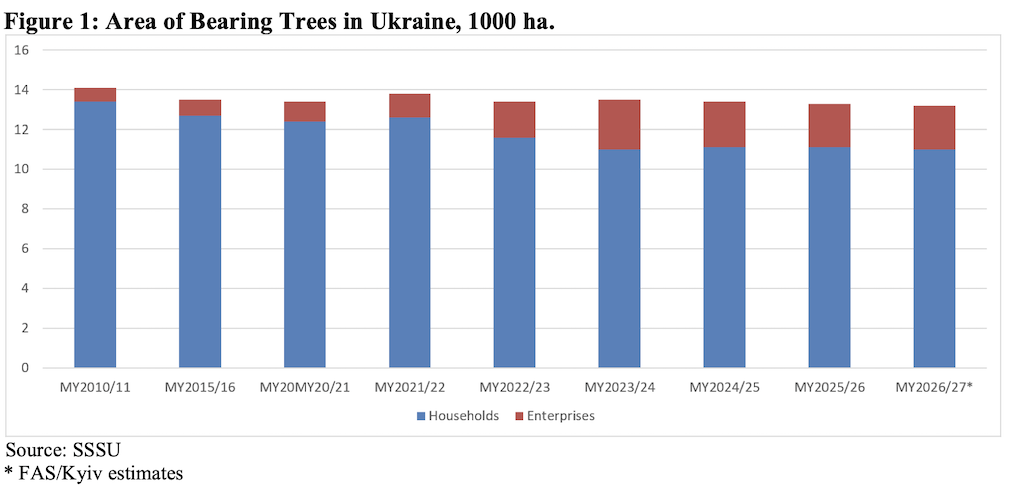
Post estimates the CY2026 total walnut production area for small, private family farms at 12,300 ha. As noted, households are decreasing production areas, and Post forecasts this downward trend will continue in the medium to long term, as aging trees lose their productivity and are chopped down. Households still hold the dominant position for production volumes; Post estimates this category accounts for 80% of the bearing tree area in CY2026. Most of Ukraine’s household walnut producers do not treat their trees for diseases, apply fertilizers, or cut their branches in a way that ensures maximum output. Some regions, especially in central and southern Ukraine, require irrigation to achieve expected yields, while orchards in northern Ukraine generally experience lower yields due to the cooler climate.
The vast majority of walnuts harvested in Ukraine are produced by individuals or small private family farms harvesting trees on their land or in the vicinity of their farms. This category of producers is not typically concerned with the application of fertilizers and agrochemicals and use manual labor for harvesting and shelling. They typically sell harvested walnuts in-shell to an intermediary who assembles batches designated for immediate export or for storage in case of low demand or unfavorable prices. According to industry, family farms are known for inconsistent batch quality, which pushes them into the low-level segment for foreign buyers.
The State Statistics Service of Ukraine (SSSU) reported calendar year (CY) 2025 numbers for enterprises and households. Overall walnut production areas in Ukraine are in decline, with both enterprises and households decreasing bearing tree areas (Figure 1).
Based on SSSU information, FAS/Kyiv estimates the total MY2025/26 production volume at 84,710 MT. Industry noted this decrease was due to frost damage, as well as wet autumn weather in CY2025 that led to damage and loss of quality, especially to walnuts that fell from trees and were not harvested shortly afterward by households.
Post estimates the CY2026 total walnut production area for small, private family farms at 12,300 ha. As noted, households are decreasing production areas, and Post forecasts this downward trend will continue in the medium to long term, as aging trees lose their productivity and are chopped down. Households still hold the dominant position for production volumes; Post estimates this category accounts for 80% of the bearing tree area in CY2026. Most of Ukraine’s household walnut producers do not treat their trees for diseases, apply fertilizers, or cut their branches in a way that ensures maximum output. Some regions, especially in central and southern Ukraine, require irrigation to achieve expected yields, while orchards in northern Ukraine generally experience lower yields due to the cooler climate.
The profitability of walnut production at the household level largely depends on whether family members have the time and ability to participate in basic processing, i.e., shelling their walnuts, which is usually done by hand. The cost of processing is tied to labor costs which have increased since the start of the full-scale Russian invasion in 2022, as the male population is being drafted into the army. Both shelled and in-shell walnuts are sold to a variety of buyers that prepare the product for export. This includes sorting and grading tree nuts purchased shelled, shelling walnuts bought in-shell from households, and packing products according to importer specifications. Read the full USDA FAS report here.
— Story by Denys Sobolev, USDA Foreign Ag Service