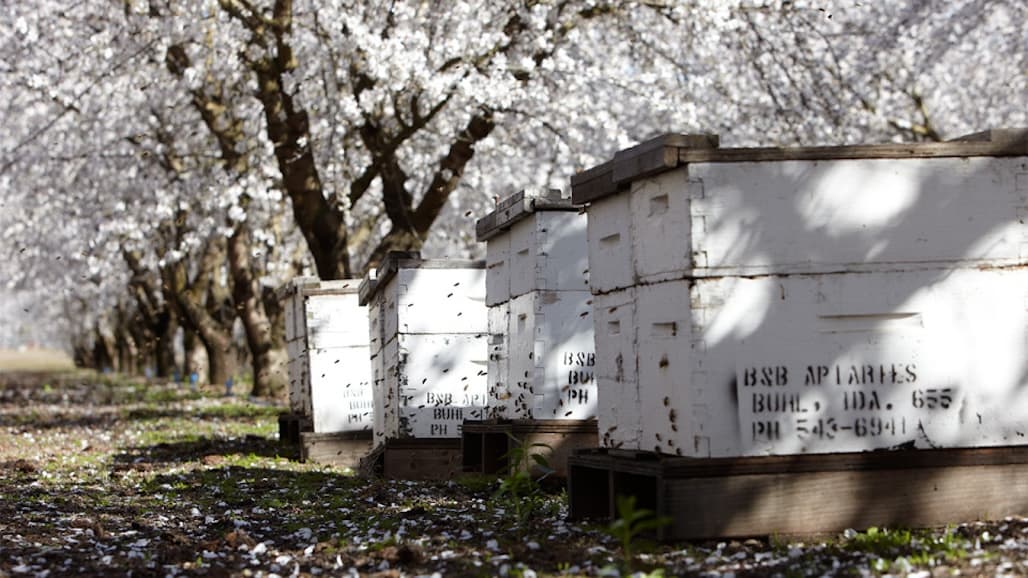
For decades, California almond growers have relied on honey bees to provide consistent pollination and ensure a successful crop. However, in recent years, the introduction of self-fertile almond varieties has offered growers more flexibility and reduced their reliance on cross-pollination. As adoption of these varieties continues to grow, researchers are working to determine whether traditional honey bee stocking rates are still necessary to maximize production.
That topic has become increasingly relevant, as honeybee rental costs remain one of the largest annual expenses for California almond growers. For most conventional varieties, the recommendation for a mature orchard is two hives per acre, costing about $200 per hive.
Putting Self-Fertile Varieties to the Test
With support from the Almond Board of California, Niño, in collaboration with Arathi Seshadri, USDA-ARS, Zac Ellis, Olam, and Angie De La Luz, Beeflow, led a two-year study, specifically evaluating honeybee stocking rates in the self-fertile Independence variety.
Conducted in 2020 and 2021, the study compared different levels of bee access and stocking rates to determine how honeybee activity affected nut set, yield, and kernel characteristics. During the first year of the study, researchers used cages to completely exclude bees from some trees, while leaving others open for traditional pollination. In the second year, they added another treatment, where trees were covered with a shade cloth, but remained open on all four sides.
Additionally, during year 2, researchers compared three honey bee stocking rates at the following levels: zero hives per acre, one per acre, or two hives per acre. Since bee spillover from neighboring conventional orchards was expected, they estimated an ambient bee presence equivalent to one-half hive per acre. Results from the first season demonstrated a clear benefit from honey bee pollination.
Researchers found that trees that were accessible to honey bees had significantly greater nut sets than trees that were excluded from honey bees. Those findings carried through to harvest, resulting in higher yields and heavier wet and dry weights from bee-pollinated trees.
They also observed increased bee activity between the no-hive treatment and one hive per acre treatment. However, increasing stocking rates from one hive per acre to two hives per acre did not significantly increase flower visitation. In fact, Niño explained that having too many bees can result in the flowers getting damaged. The ideal number is referred to as optimal stocking rate.
Advertisement
“We still had a presence of bees with the one hive per acre,” she explained. “With the two hives per acre, we did have increased visitation rate. Between one hive and two hives, there was actually no significant difference.”
Taking it a step further, the researchers also examined kernel mass by evaluating samples of 100 kernels from the caged and uncaged trees. They found that while bee-pollinated trees produced more nuts overall, the average kernel mass was slightly lower. “This is not necessarily surprising because if you have a really high number of nuts on the tree, the tree has to reallocate resources in such a way so that it can produce all of these nuts, but they might be smaller,” Niño said.
The second phase of the study focused on determining whether these trees were indeed pollinated by the honey bees present in the orchard. In year two of the study, a group of research technicians went to the site and counted the number of bees over a five-minute period. Numbers were taken in the morning and evening, which were then averaged. As expected, the technicians observed fewer bees visiting flowers in the “no hives” treatment, even with ambient presence of bees taken into account.
Weighing the Costs and Benefits
Ultimately, the findings point to an economic decision for growers. While this study supports that there is a direct benefit to rent hives even on self-pollinating Independence orchards, growers must weigh the additional yield against the cost of pollination. “It’s up to you as a grower to decide whether you are willing to eat the cost of renting the hives in return for increased yield and in return for increased profit,” Niño reiterated.
The study conducted by Niño and her team provided valuable insight, however Niño emphasized that additional research is needed, especially as more self-fertile varieties become available to growers. “It was a smaller-scale study, and we are assuming that some of that does translate to the newer varieties that are coming out,” Niño concluded. “We would love to continue that research and solidify guidelines for the growers.”
— Story contributed by the Almond Board of California